

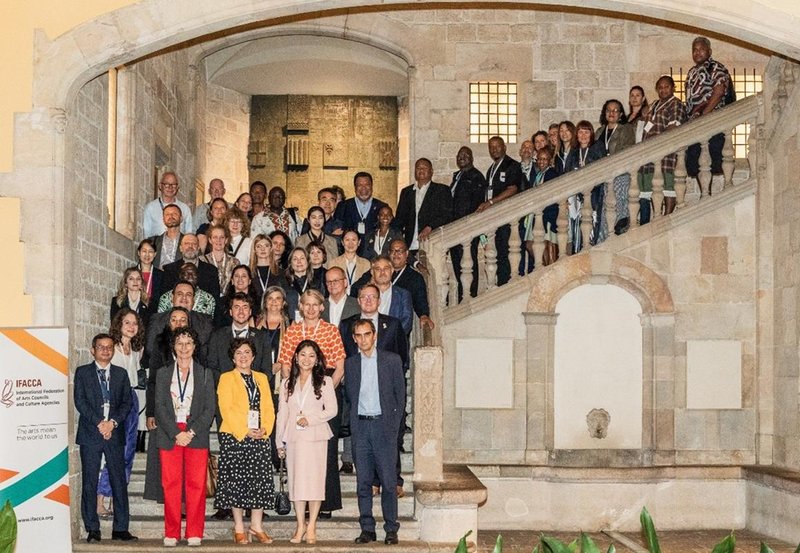
Image: IFACCA delegation at MONDIACULT 2025 at the Archives of the Crown of Aragon. Photo courtesy of CoNCA.
The UNESCO World Conference on Cultural Policies and Sustainable Development – MONDIACULT 2025 concluded in Barcelona, Spain on 1 October with Ministers of Culture from around the world recognising culture as a human right in the Outcome Document of the 2025 conference. The Outcome Document reaffirms the MONDIACULT 2022 Declaration and advocates for the consideration of culture as an ‘independent goal in its own right’ within the next United Nations development strategy beyond 2030. This was also highlighted by the Minister of Culture of Spain, Mr Ernest Urtasun Domènech at the closing ceremony stating: ‘Now we have a shared objective, all of us here in this room, to obtain a standalone goal for culture in the next development agenda, we will manage this and we will achieve this.’ The 2025 Outcome Document also states: ‘Between MONDIACULT of 2022 and 2025, ongoing discussions have stressed that culture is both an indispensable driver and an enabler of sustainable development and must be included as an integral component and pillar of it. This message is carried by institutions, professionals, communities and civil society around the world. There is no future without culture.’ Moreover, the Outcome Document calls for urgent action to address global challenges with Ministers of Culture affirming their commitment to: ‘strengthened multilateralism, in which culture stands as a cornerstone of global cooperation, solidarity, and respect for human rights.’
Convened by UNESCO and hosted by the Government of Spain, MONDIACULT 2025 built on the legacy of MONDIACULT 2022 and 1982 and brought together 2,500 delegates and more than 160 ministerial delegations. Thanks to the partnership between IFACCA and UNESCO and supported by the Ministry of Culture of Spain (IFACCA National Member), IFACCA had an important representation with a large delegation attending MONDIACULT 2025, with over 70 representatives of Member Institutions including Secretariat staff.
IFACCA activities began on 27 September with the participation of IFACCA’s Chair Ms Kajsa Ravin and Executive Director Ms Magdalena Moreno Mujica at the Sitio Futuro Forum, a forum focused on the future of financing culture, which took place at the Museum of Contemporary Arts of Barcelona (MACBA). On 28 September in the morning, IFACCA participated as an official observer at the 22nd meeting of the Ministers of Culture of Ibero-America.
IFACCA Members convened on the afternoon of 28 September at the iconic Archives of the Crown of Aragon, including regional chapter meetings in collaboration with the Ministry of Culture of Spain and supported by Consell Nacional de la Cultura i de les Arts – CoNCA (National Council of Culture and Arts, Catalonia and IFACCA Affiliate Member), also hosted at the Museu d'Història de Barcelona. Key to member discussions were the inherent links between cultural rights and the economy of culture and to ensure that culture is for all, requiring resource mobilisation across all dimensions of culture. The evening concluded with a reception at the Museu Frederic Marès hosted by CoNCA, as an informal networking opportunity with local cultural leaders in the sector and policy space, accompanied by wonderful Catalan gastronomy. You can view our MONDIACULT 2025 photo gallery here.
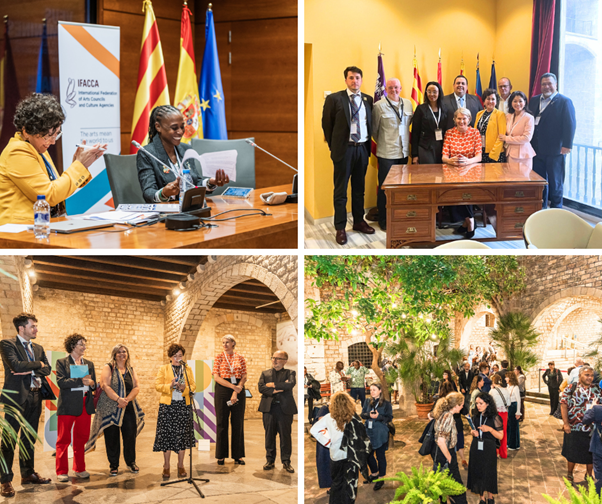
Image: IFACCA delegation at MONDIACULT 2025. Photo courtesy of CoNCA.
On the first day of MONDACULT 2025, IFACCA hosted the side event Sustainable pathways for charting the future of arts and culture: In conversation with public agencies at the International Convention Centre of Barcelona (CCIB) in collaboration with the Ministry of Culture, Spain. Our panel featured leaders from Cook Islands, Poland, Sweden, Uruguay, Viet Nam, and Zimbabwe, and discussed both priorities and opportunities to reimagine sustainable pathways for the value of culture, its investment and diverse types of support.
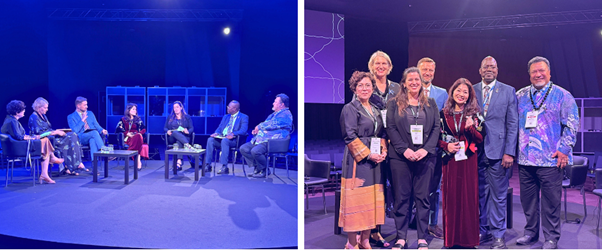
Image: IFACCA side event panel at MONDIACULT 2025. Photo courtesy of IFACCA.
Key to IFACCA’s participation, we published our Dossier for MONDIACULT 2025 – Charting the future: culture as our compass which draws on expertise from the IFACCA community and insights from over 400 delegates from across the world shared at the 10th World Summit on Arts and Culture. Published and delivered to UNESCO in July, this document analysed, in advance, the thematic priorities of MONDIACULT 2025, providing key insights and recommendations under each area succinctly. It is available in four languages – English, Spanish, French and Catalan – and can be accessed via our website as well the UNESCO’s MONDIACULT Digital Library.
In addition to the MONDIACULT 2025 Outcome Document, several other important declarations emerged from the conference. The Declaration adopted at the 22nd Ibero-American Conference of Ministers of Culture called for ‘the current Ibero-American Cultural Charter to be updated to respond to the challenges facing the sector in areas such as gender equality, diversity, digital transformation, cultural rights, and the connection between culture, climate, and sustainability’. A civil society Declaration – the result of the Àgora Cívica programme – called for ‘a firm commitment that is transformative with cultural rights for all people, with culture as a global public good’. The MondiaYouth statement from young people, presented seven priority actions including ‘effort must be made to increase accessibility to culture. Digital connectivity and inclusive infrastructures must be recognised as basic public services’. And the Barcelona Declaration by the Group of Friends for Culture-Based Climate Action included an agreement to: ‘Accelerate climate action within the culture sector by pursuing initiatives aimed at promoting adaptation plans for safeguarding tangible and intangible cultural heritage, protecting natural heritage, and preserving the diversity of cultural expressions from the adverse impacts of climate change and biodiversity loss, as well as reducing the carbon emissions of these sectors in our respective countries’. This group also agreed to reconvene next month at COP30 in Belém, Brazil.
Furthermore, a number of other significant publications were announced at MONDIACULT 2025 including the first-ever Global Report on Cultural Policies: UNESCO Global Report on Cultural Policies – Culture: The missing SDG, which provides comprehensive global data on culture and public policy, with IFACCA’s Executive Director contributing to this landmark report as a member of the Editorial Board. IFACCA also joined the expert group in the development of the new UNESCO Institute for Statistics Framework for cultural statistics, launched at the conference, which establishes a conceptual and methodological framework redefining how culture is understood and measured today. For more publications specific to MONDIACULT 2025, the UNESCO Digital Library also serves as a valuable resource, hosting key documents including our dossier, the Pacific Ministerial Statement – MONDIACULT 2025 by the Pacific Community, a Green Paper on the Sustainable Management of Cultural Heritage by the Ministry of Culture of Spain, and other conference materials.
We will continue to reflect on the results of MONDIACULT 2025, share our insights from IFACCA, and further discussions from the broader arts and culture policy ecology. As always, we remain attentive to ongoing developments on international arts and culture policy news and if you have news or publications to share, please email info@ifacca.org.
Read the Full Newsletter
Subscribe to ACORNS newsletters
ACORNS Octubre de 2025: Nuestra visión compartida en MONDIACULT 2025: no hay futuro sin cultura
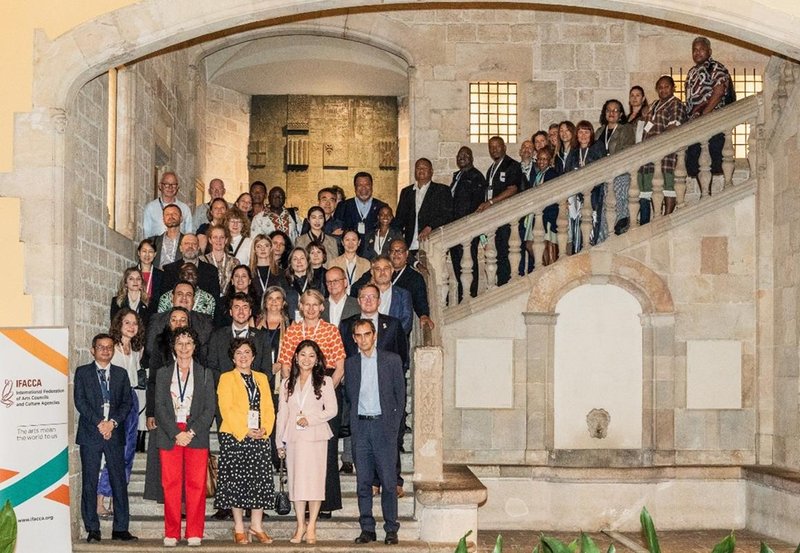
Imagen: Delegación de IFACCA en MONDIACULT 2025 en el Archivo de la Corona de Aragón. Foto cortesía: CoNCA.
La Conferencia Mundial de la UNESCO sobre Políticas Culturales y Desarrollo Sostenible – MONDIACULT 2025 concluyó en Barcelona, España, el 1 de octubre con los(as) ministros(as) de Cultura de todo el mundo reconociendo la cultura como un derecho humano en el Documento final de la conferencia de 2025. Este documento reafirma la Declaración MONDIACULT de 2022 y aboga por considerar la cultura como un “objetivo independiente por derecho propio” en la próxima estrategia de desarrollo de las Naciones Unidas post 2030, como también destacó el ministro de Cultura de España, Sr. Ernest Urtasun Domènech, en la ceremonia de clausura. En ella, afirmó que “ahora tenemos un objetivo compartido, todos(as) los que estamos aquí en esta sala, de conseguir un objetivo propio para la cultura en la próxima agenda de desarrollo. Lo gestionaremos y lo lograremos.” El Documento final de 2025 también señala: “Entre MONDIACULT 2022 y 2025, las discusiones en curso han puesto de relieve que la cultura es tanto un motor indispensable como un facilitador del desarrollo sostenible, y debe ser incluida como un componente integral y un pilar de este. Este mensaje es respaldado por las instituciones, los(as) profesionales, las comunidades y la sociedad civil alrededor del mundo. No hay futuro sin cultura”. Además, el Documento final hace un llamado a la acción urgente para abordar los desafíos globales, con los(as) ministros(as) de Cultura reafirmando su compromiso con “un multilateralismo fortalecido, en el que la cultura es la piedra angular de la cooperación mundial, la solidaridad y el respeto por los derechos humanos.”
Convocada por la UNESCO y organizada por el Gobierno de España, MONDIACULT 2025 partió del legado de MONDIACULT 2022 y 1982, reuniendo a 2500 delegados(as) y más de 160 delegaciones ministeriales. Gracias a la colaboración entre IFACCA y UNESCO, y con el apoyo del Ministrerio de Cultura de España (Miembro Nacional de IFACCA), IFACCA tuvo una representación destacada, con una gran delegación en MONDIACULT 2025, compuesta por más de 70 representantes de las instituciones miembros y personal del Secretariado.
Las actividades de IFACCA comenzaron el 27 de septiembre con la participación de la presidenta de IFACCA, Sra. Kajsa Ravin, y la directora ejecutiva, Sra. Magdalena Moreno Mujica, en el Sitio Futuro Forum, un foro centrado en el futuro del financiamiento de la cultura, que tuvo lugar en el Museo de Arte Contemporáneo de Barcelona (MACBA). El 28 de septiembre por la mañana, IFACCA participó como observador oficial en la 22ª reunión de ministros(as) de Cultura de Iberoamérica.
Los Miembros de IFACCA se reunieron durante la tarde del 28 de septiembre en el emblemático Archivo de la Corona de Aragón para celebrar las reuniones de los Capítulos Regionales en colaboración con el Ministerio de Cultura de España y con el apoyo del Consell Nacional de la Cultura i de les Arts – CoNCA (Consejo Nacional de la Cultura y las Artes de Cataluña y Miembro Afiliado de IFACCA), también en el Museu d'Història de Barcelona. Un tema clave en las discusiones entre los Miembros fue la relación inherente entre los derechos culturales y la economía de la cultura, así como la necesidad de garantizar que la cultura sea para todos(as). Esto requiere la movilización de recursos en todas las dimensiones de la cultura. El evento concluyó con una recepción en el Museu Frederic Marès auspiciada por el CoNCA, espacio que sirvió como una oportunidad para generar contactos informales con los(as) dirigentes culturales locales del sector y de políticas públicas, acompañado por una maravillosa muestra de la gastronomía catalana. Puede ver nuestra galería de fotos de MONDIACULT 2025 aquí.
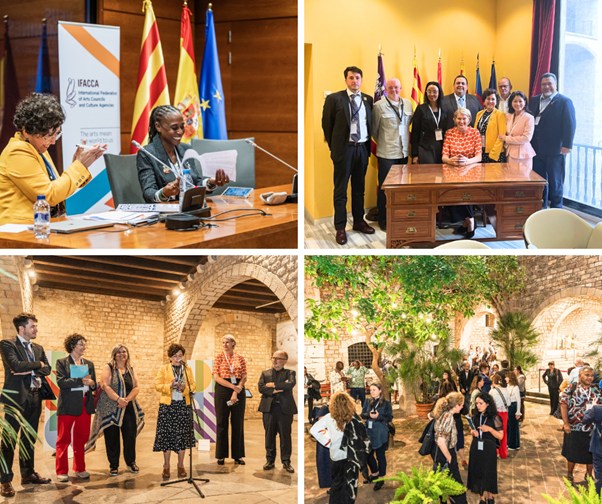
Imagen: Delegación de IFACCA en MONDIACULT 2025. Foto cortesía: Consell Nacional de la Cultura i de les Arts – CoNCA.
El primer día de MONDIACULT 2025, IFACCA organizó el evento paralelo Rutas sostenibles para trazar el el futuro de las artes y la cultura: una conversación con agencias públicas en el Centro Internacional de Convenciones de Barcelona (CCIB), en colaboración con el Ministerio de Cultura de España. Nuestro panel contó con líderes de las Islas Cook, Polonia, Suecia, Uruguay, Vietnam y Zimbabue, y abordó tanto las prioridades como las oportunidades para reimaginar rutas sostenibles en torno al valor de la cultura, su inversión y los diversos tipos de apoyo.
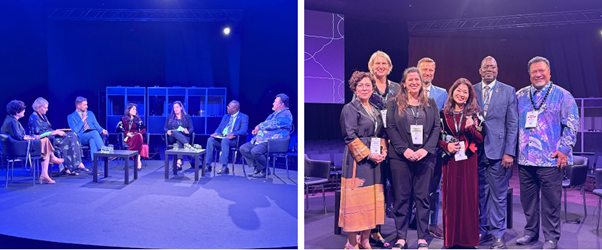
Imagen: Panel paralelo de IFACCA en MONDIACULT 2025. Foto cortesía: IFACCA.
Como parte clave de la participación de IFACCA, publicamos nuestro Dossier para MONDIACULT 2025 – Trazando el futuro: la cultura es nuestra brújula, que aporta la experticia de la comunidad de IFACCA así como las ideas que compartieron los(as) más de 400 delegados(as) de todo el mundo en la 10ª Cumbre Mundial de las Artes y la Cultura. Publicado y entregado a la UNESCO en julio, este documento analizó de forma anticipada las prioridades temáticas de MONDIACULT 2025, proporcionando ideas clave y recomendaciones bajo cada área de enfoque. El documento está disponible en cuatro idiomas –inglés, español, francés y catalán– y puede accederse mediante nuestra página web, así como desde la Biblioteca Digital MONDIACULT de la UNESCO.
Además del Documento final de MONDIACULT 2025, se produjeron declaraciones significativas en el transcurso de la Conferencia, como la Declaración adoptada por la 22a Conferencia Iberoamericana de Ministros(as) de Cultura, llamó a “actualizar la Carta Cultural Iberoamericana para responder a los desafíos que afronta el sector en áreas como la igualdad de género, la diversidad, la transformación digital, los derechos culturales y la relación entre cultura, clima y sostenibilidad”. Una Declaración de la Sociedad civil –resultado del programa Àgora Cívica– llamó a un ‘compromiso firme y transformador que extienda los derechos culturales a todas las personas, y la cultura como un bien público mundial”. La declaración MondiaYouth de los(as) jóvenes presentó siete acciones prioritarias entre las que ‘se deben hacer esfuerzos para aumentar la accesibilidad de la cultura. La conectividad digital y las infraestructuras inclusivas deben ser reconocidas como servicios públicos básicos”. Finalmente, la Declaración de Barcelona del Grupo de Amigos(as) por la Acción Climática basada en la Cultura incluía un acuerdo para “acelerar la acción climática en el sector cultural mediante iniciativas para promover planes de adaptación para la salvaguardia del patrimonio cultural material e inmaterial, proteger el patrimonio natural y preservar la diversidad de expresiones culturales de los efectos adversos del cambio climático y la pérdida de biodiversidad, además de reducir las emisiones de carbono en nuestros respectivos países”. Este grupo se reunirá de nuevo el mes próximo en la COP30 de Belén, Brasil.
Finalmente, también se anunciaron diversas publicaciones relevantes en MONDIACULT 2025, como el primer informe mundial sobre políticas culturales: Informe Mundial de la UNESCO sobre Políticas Culturales - La cultura: el ODS ausente, que ofrece una extensa información mundial sobre la política cultural pública. La directora ejecutiva de IFACCA contribuyó a este informe pionero en tanto que miembro del consejo editorial. IFACCA también participó en el grupo de expertos(as) en el desarrollo del nuevo Marco de estadísticas culturales del Instituto de Estadística de la Unesco, publicado durante la Conferencia, cuyo marco conceptual y metodológico redefine cómo se entiende y mide la cultura actualmente. La Biblioteca Digital de la UNESCO es un valioso recurso para encontrar otras publicaciones relacionadas con MONDIACULT 2025, como Nuestro dossier, la Declaración Ministerial del Pacífico – MONDIACULT 2025 de la Comunidad del Pacífico (SPC), un Libro verde para la gestión sostenible del patrimonio cultural del Ministerio de Cultura de España, y otros recursos de la Conferencia.
Seguiremos reflexionando sobre los resultados de MONDIACULT 2025, compartiendo nuestras perspectivas desde IFACCA y continuando las discusiones dentro de la ecología amplia de las políticas artísticas y culturales. Como siempre, permanecemos atentos a los desarrollos internacionales en políticas culturales. Si tiene noticias o publicaciones para compartir, por favor escríbanos a info@ifacca.org.