

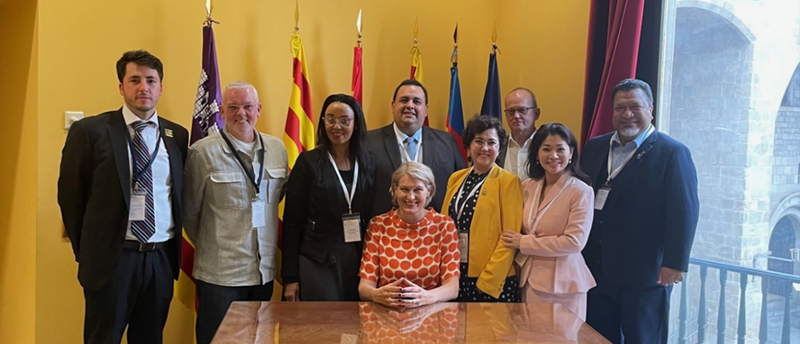
Image: IFACCA Board in Barcelona (as at September 2025) for MONDIACULT 2025 including (L-R): Rafael Ivorra Zaragoza (Ministry of Culture, Spain); Iain Munro (Creative Scotland); Julie Diphofa (National Arts Council of South Africa); Humberto López La Bella (National Secretary of Culture, Paraguay); Kajsa Ravin (Swedish Arts Council); Magdalena Moreno Mujica (IFACCA); Adrian Collette AM (Creative Australia); Nguyen Phuong Hoa (Ministry of Culture, Sports and Tourism, Viet Nam) and Emile Kairua (Ministry of Cultural Development, Cook Islands). Photo credit: IFACCA.
Engaging with IFACCA is an excellent way to understand the world
During my six years as Director General of the Swedish Arts Council, I have had the privilege of serving as a board member of IFACCA, and most recently as its Chair, working alongside a dynamic board that reflects the rich diversity of IFACCA’s members from every corner of the globe.
These years have been intense, challenging, and deeply instructive for all of us who operate within the cultural ecosystem, shaping policy, practice, and methods. The pandemic’s devastating effects across the world struck the cultural sector particularly hard, and in many places it has yet to recover. Conflicts and geopolitical tensions further impede the work of the arts and culture sector in our respective countries and exert growing pressure on international cooperation. In this world of multiple, overlapping crises, IFACCA has continued to create inclusive spaces for learning and dialogue about the conditions for the arts and culture, and to inspire action that moves us from words to practice in safeguarding cultural rights.
During my time on IFACCA’s board, we have experienced two moments in which IFACCA’s World Summits intersected with UNESCO’s Mondiacult. In 2022, delegations from UNESCO member states met in Mexico City to look toward the future sustainability agenda and the role of culture within it. IFACCA’s national members were invited and formed a joint delegation. In May 2023, the Swedish Arts Council were finally able to host IFACCA’s 9th World Summit on Arts and Culture in Stockholm, Sweden. It was an emotional experience to finally be there, after planning this global gathering throughout the pandemic, encountering setbacks and changes of government in Sweden. The theme was safeguarding artistic freedom, and over 400 delegates from 90 countries gathered in a chilly but beautiful Stockholm. A wealth of experiences and perspectives was shared among delegates in safe and respectful spaces. We learned that conditions and circumstances vary greatly around the world. In many places, the space for artists to create freely and for audiences to choose cultural experiences is severely restricted. The need for artistic freedom and cultural rights is not only desirable — it is essential for the arts and culture to flourish and human rights to be fulfilled.
Last year, it was time once again, when the 10th World Summit took place in Seoul, South Korea, hosted by our colleagues at Arts Council Korea. It was an extraordinary experience to come to Seoul and learn from South Korea’s modern history and how it has shaped cultural policy. The need and value of coming together to delve into the theme of Charting the Future of Arts and Culture helped us set our sights on the solutions that must be developed despite the many challenges we face. AI and technological development are advancing rapidly and are understandably causing concern among artists and cultural workers. This meant that many panels at last September’s Mondiacult in Barcelona addressed the question of how AI can be regulated — one of the most significant cultural policy issues of our time. How can diversity and artistic freedom be secured now and in the future?
Dear IFACCA community, it is time for me to move on, but one thing is certain — you are needed more than ever. In many places, the world is on fire. Your experience, curiosity, and commitment to do better mean that positive development for arts and culture worldwide remains possible. I want to thank you all: our outstanding Executive Director, Magdalena Moreno Mujica, and team, every board member over the years, and all our members. I will be following your work closely from my place in the world, up north, to better understand the world we live in.
Thank you for letting me be part of the IFACCA family; it has truly been an honour.
Kajsa Ravin
Chair IFACCA
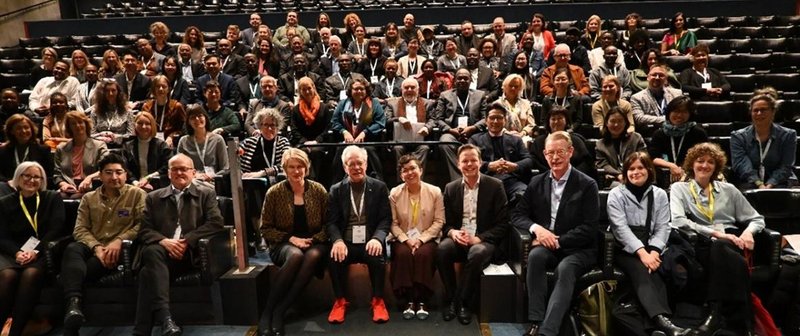
Image: IFACCA Members gather in Stockholm, Sweden in May 2023 for the 9th World Summit on Arts and Culture. Photo credit: Susanne Kronholm.
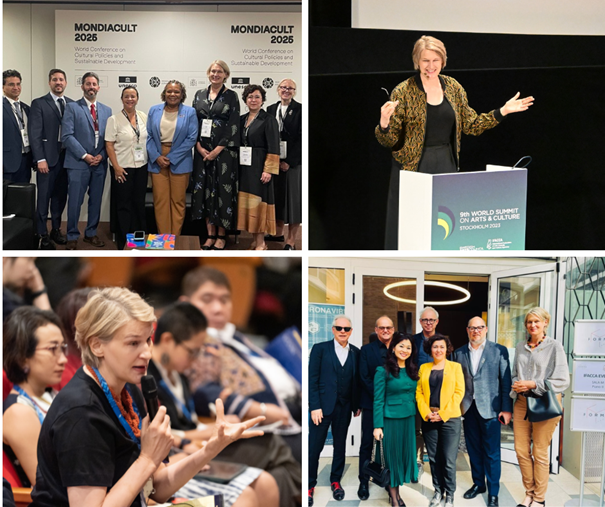
Top images (L-R): IFACCA high level meeting with the Minister of Culture of Brazil H.E. Margareth Menezes and her delegation from the Ministry of Culture of Brazil at MONDIACULT 2025. Photo credit: IFACCA; and Kajsa Ravin, Director General, Swedish Arts Council welcomes IFACCA Members to Stockholm for the 9th World Summit on Arts and Culture in May 2023. Photo credit: Susanne Kronholm.
Bottom images (L-R): Kajsa Ravin at the 10th World Summit in Seoul in May 2025. Photo credit: © PILHO SEUNG, courtesy of ARKO and IFACCA; and the IFACCA Board meeting in Rome, in April 2022 – the first in-person Board meeting post-pandemic. Photo credit: IFACCA.