

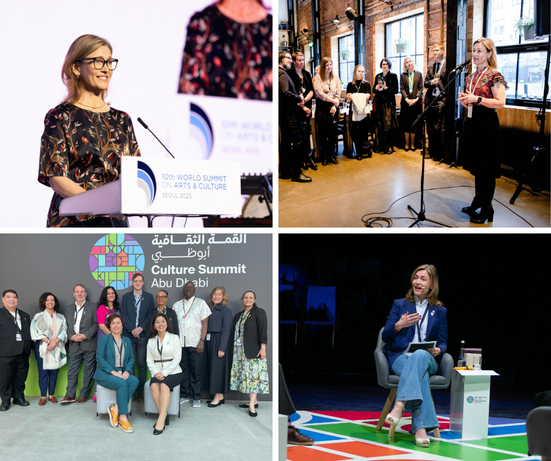
Images top (left to right) Kristin Danielsen, IFACCA Chair at the Gala Opening for the 10th World Summit. Photo credit: © PILHO SEUNG, courtesy of ARKO and IFACCA. Kristin Danielsen presenting at the 23rd meeting of the Europe Chapter in Tartu, Estonia in April 2024. Photo credit: Signe Oidekivi.
Images bottom: IFACCA delegation at Culture Summit Abu Dhabi 2024 and Kristin Danielsen participating in IFACCA’s panel The Clock is Ticking: Leading Public Agencies for Culture in Times of Polycrisis at Culture Summit Abu Dhabi 2024. Photo credit: @DCTAbuDhabi
A living, breathing community of practice in action
Serving as Chair since May 2023 has been a profound experience. It has deepened my understanding of the global cultural ecosystem and strengthened my belief in the importance of coming together to learn from one another. IFACCA is more than a federation; it is a living, breathing community of practice in action. And it is in this community that I have found some of the most meaningful conversations and collaborations in my professional life so far.
Many of these took place recently, at the 10th World Summit on Arts and Culture in Seoul, Republic of Korea, co-hosted with Arts Council Korea The Summit was a testament to the strength of our global community and its unwavering commitment to cultural transformation.
In a world marked by crises, conflict, and rapid change, the Summit reminded us of the importance of dialogue, mutual learning, and collective action. We explored how culture can shape global governance beyond 2030, and how our shared values can be translated into concrete commitments. The energy, insight and solidarity I witnessed in Seoul will stay with me for a long time.
Our members come in all shapes and sizes, each formed by its own cultural, political, and historical context. What has always amazed me is how we share so many aims and objectives, but no two agencies operate in the same way. That is why coming together to learn from each other remains so very important. Running a cultural agency is certainly a continuing learning process.
In the opening panel in Seoul, we explored the future of culture in times of exponential shifts. What future do we envision for culture? With my brilliant panellist we agreed on a few non-negotiable components moving forward.
We must resist the war on diversity because diversity is foundational to the vitality, relevance, and resilience of arts and culture globally. Resisting the war on diversity means standing against forces that seek to homogenise cultural expression or silence minority voices. It means defending the right of every community to tell its own stories, in its own language, through its own artistic forms. In doing so, IFACCA affirms that cultural rights are human rights.
And cultural rights matter. We can, as a federation of 91 members from over 70 countries, make sure to use and implement the tools that are already there in international, legal frameworks.
Finally, we agreed that we must still believe in multilateralism. In our world today this is becoming increasingly challenging. We see a growing call for sovereign isolation, for walls instead of bridges. Where we once sought shared stories and values, we now compete to have the best story. This should concern us all.
Multilateralism is not just a political principle, it is a cultural necessity. There is quite simply no future for monocultures, and coexistence is our only option. The scale and complexity of today’s global challenges demand coordinated, multilateral responses, only through collective action can we address the interwoven crises of our time.
In Seoul, our conversations showed that culture is not peripheral to progress, it is central to it. Cultural policies, agencies and institutions must evolve from national guardians to global collaborators. And we must champion artistic freedom, so that artists everywhere may speak truth to power, without fear.
IFACCA is living proof that when we come together across borders, languages, and systems, we are equipped to design a future path for culture. And all we discussed, shared and learned will be part of IFACCA’s presentation at MONDIACULT 2025 in Barcelona this September.
I am deeply grateful to the IFACCA Secretariat, led by Magdalena Moreno Mujica, for their tireless work and unwavering commitment. Your ability to hold complexity with care and clarity is what makes this Federation so impactful. To my fellow Board members: thank you all, it has been a privilege to serve alongside you. Additionally, I think you made a very good choice by electing my colleague and dear friend Kajsa Ravin as the new Chair. I’m confident that she will be a strong and thoughtful convener for the Federation.
And to the wider IFACCA community: thank you for your trust, your collaboration, and your belief in the transformative power of the arts. You have reminded me that cultural leadership is never about the leader – it is about the community we manage to create. And I am very happy to remain part of this community, taking on a new role with an Affiliate Member institution.
Starting 25 August, I will be the Director of the Nordic Culture Fund, a catalyst for cultural exchange and artistic collaboration across the Nordic region and beyond. The Nordic Culture Fund has been an Affiliate Member of IFACCA since 2018.
Thank you for allowing me to be part of this journey. I look forward to continuing our work together in new ways, and to supporting the next chapter of this remarkable Federation.
With heartfelt thanks,
Kristin Danielsen
Chair, IFACCA Board (2023–2025)